World Caviar Awards 2026: Why We're Taking Two Tins to Paris
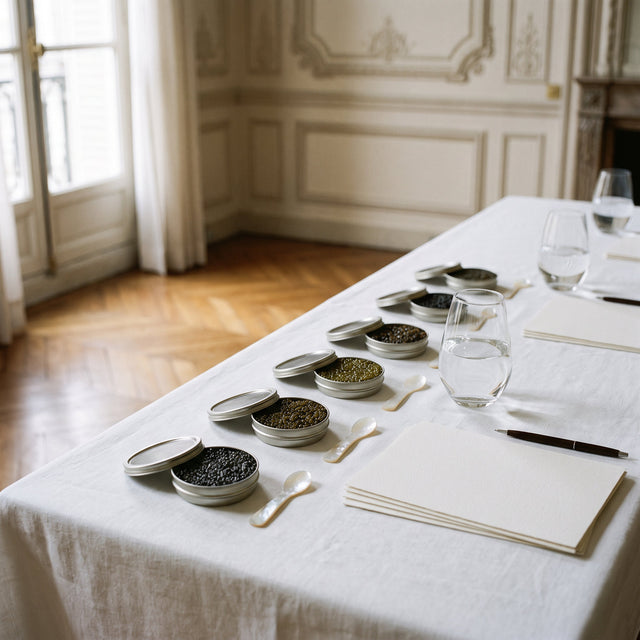
On 12 November 2026, the World Caviar Awards take place in Paris for the third time, at the Alcazar. Producers from around the world send their caviar to be tasted blind by a jury. We'll be there – with two tins, and one notable absence.
Why enter at all?
Most caviar sold in Europe passes through several hands before it reaches a table. Blind tastings strip all of that away: no brand, no packaging, no story. Just the roe. For a small producer like us, that's exactly the test we want. I make every tin myself, at the Grüll sturgeon farm in Salzburg – from deciding when a fish is ready, to washing, salting and filling. If the work is good, a blind jury should taste it. If it isn't, I want to know.
That's also why we compete in the producer category. We don't buy in and repack. Every tin is filled once, within minutes of the harvest, and not opened again until it reaches you.
The two caviars we're entering
Imperial Baerii is our everyday caviar, if caviar can ever be called that. Siberian sturgeon, medium glossy pearls, nutty and clean. It's the caviar most of our customers start with, and the one I'd want to be judged by.
Titan Selection comes from the same species, but only from the small fraction of a harvest that exceeds every standard: the largest grains, the deepest chocolate-brown colour and an unusual creaminess. Around five percent of a year's production qualifies. And it comes only from older females, so-called second spawners of roughly 16 to 20 years, which have been through several ovulation cycles before harvest. Hardly anyone waits that long; we do, because the roe gets better with each cycle.
Both are unpasteurised, with nothing added but salt.
Why our Albino stays at home
People have asked why we're not entering Royal Albino, our rarest caviar. The answer is simple. Albino sturgeon occur roughly once in ten thousand fish and take many years to mature. We only harvest one when the roe is right and there's a reason to. A competition isn't a reason. I won't take an animal like that for a medal.
Our Osietra isn't entered either – it's produced in very small quantities and isn't available all year, and I'd rather it went to customers.
What happens next
The tasting and gala take place on the evening of 12 November in Paris. French television (TF1, Grands Reportages) is covering the competition, and the medallists will be published in the awards magazine in mid-December. We'll share the results here and on Instagram as soon as we have them – whatever they are.
Until then, the best way to judge for yourself is the same way the jury will: plain, from a mother-of-pearl spoon, nothing else. Our guide how to eat caviar explains how.