Malossol Caviar Explained: Why Great Caviar Needs Only Roe and Salt
Turn over a tin of fine caviar and you will often find the word Malossol. It is Russian for "little salt" - and it is less a flavour description than a quality promise: roe good enough that it does not need to hide behind salt.
What salt actually does in caviar
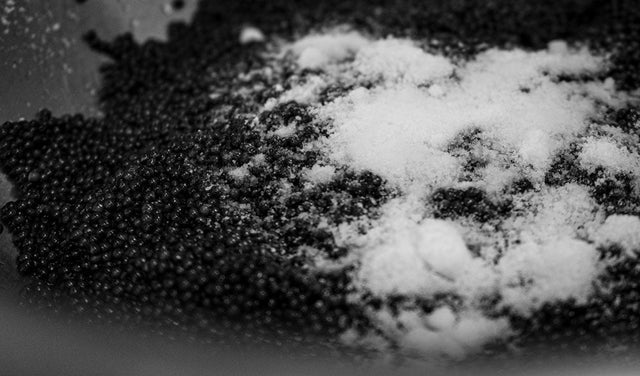
Salt does three jobs. It seasons, it draws out moisture and firms the pearl, and it preserves. Historically, heavily salted caviar was a way to survive long transport without refrigeration. Malossol reverses the logic: with salt content typically well under 4 percent, the roe itself has to be flawless, because there is nothing to mask it. Salting is the moment of truth in caviar making - a question of grams and minutes, decided by hand at the point of harvest.
What we leave out
Some producers extend shelf life with preservatives or with pasteurisation. Both work - and both change the product. Preservatives can alter taste; heat firms the membrane and flattens the aromatics. Our position is simple: every tin we sell contains roe and salt, nothing else. Unpasteurised, preservative-free, harvested weekly so that a long shelf life is never needed in the first place. How that affects storage, we explain in our shelf-life guide.
Golden Reserve: choose your own salting
Because salting defines the character of a caviar, we did something unusual: with Golden Reserve you decide the salting level yourself - or provide a fully custom salt recipe, which we apply to your batch at harvest. To our knowledge a world first, and only possible because our production runs weekly and in small, dedicated lots.
How to taste the difference
Try lightly salted, unpasteurised caviar pure, on the back of your hand or a mother-of-pearl spoon. The first thing you notice is what is missing: no salty edge, no metallic note. Then the actual flavours arrive - nutty, creamy, mineral, depending on the variety. That is what Malossol is for.