What Does Caviar Taste Like? Flavour, Texture and the Differences Between Varieties
The short answer: good caviar tastes gently salty, buttery and a little nutty, with a fresh, clean note that reminds most people of sea air rather than fish. The pearls pop on the tongue and release a creamy, almost silky liquid. The flavour lingers for a while after you swallow. If caviar tastes strongly fishy, bitter or metallic, something has gone wrong – with the caviar, the storage or the spoon.
That is the general picture. But caviar is not one taste. A spoonful of Siberian sturgeon roe and a spoonful of albino roe are as different as two wines from the same region. Here is what to expect, variety by variety, and why fresh caviar should never taste of fish.
What caviar tastes like, in five words
- Salt – the first thing you notice. Fine caviar is lightly salted (malossol), so the salt frames the flavour instead of covering it.
- Butter – the creamy, round middle, strongest in fresh, unpasteurised roe.
- Nut – hazelnut or walnut, more pronounced in older, larger sturgeon.
- Mineral – a clean, almost oyster-like brightness at the end.
- Length – good caviar keeps developing on the palate for several seconds. Cheap caviar is gone at once.
Taste by variety
The species of sturgeon decides most of what you taste. These are the caviars I make at the Grüll sturgeon farm in Austria, side by side:
| Caviar | Salt | Butter | Nut | Grain | Character |
|---|---|---|---|---|---|
| Imperial Baerii | medium | high | medium | medium, soft | Balanced, smooth, clean finish. The best first caviar. |
| Osietra | medium | medium | high | large, firm | Deeper, mineral, a long finish that keeps changing. |
| Platinum Selection | medium | high | high | large, lustrous, firm pop | Silver-grey, a long nutty finish. Not briny, not heavy. |
| Titan Selection | medium | very high | high | the largest | Deep chocolate-brown. The most complex flavour, extraordinarily creamy, a long finish. |
| Royal Albino | low | very high | low | medium, very delicate | Extremely fine and creamy. Quiet rather than loud. |
| Red Pearl (trout roe) | medium | low | none | large, firm pop | Bright, fresh, juicy. A different food from sturgeon caviar. |
Imperial Baerii is what most people imagine when they think of caviar: dark, glossy pearls, a soft nutty creaminess and a finish that stays clean. It is the caviar we recommend for a first tasting, because nothing about it is difficult.
Osietra is for people who already know caviar. The grains are larger and firmer, the flavour more mineral and more complex. Where Baerii is round, Osietra has edges.
Platinum Selection is a grade, not a separate product: only roughly 10 % of our annual production qualifies. Large, lustrous silver-grey pearls with a firm pop and a long nutty finish – not briny, not heavy. It is available only when that week's harvest yields it.
Titan Selection begins where Platinum ends: roughly 5 % of our production, with the largest grains and the deepest chocolate-brown colour. Its flavour is the most complex of all our caviars – extraordinary creaminess, pronounced nuttiness and a long finish.
Royal Albino comes from albino sturgeon and is pale ivory to golden. It is the mildest and most buttery of all, which is exactly why it should be tasted plain and never next to something strong.
Red Pearl is not sturgeon caviar but roe from Austrian rainbow trout. It tastes brighter and juicier, with a firm pop and almost no nuttiness. More on the differences between all types in our varieties guide.
Why fresh caviar doesn't taste fishy
A fishy smell or taste is not the taste of caviar. It is the taste of oxidation – roe that is old, has been warm for too long, or was heavily processed to make it last. Three things decide whether caviar tastes clean:
- Freshness. I make our caviar myself at the Grüll sturgeon farm: salted and closed in the tin straight after the harvest. No intermediate storage, no repacking.
- No pasteurisation. Heat makes caviar last longer on a shelf, but it firms the pearls and flattens the flavour. Unpasteurised caviar keeps its creaminess – it just has to stay cold. How long it lasts is explained in how long does caviar last.
- Little salt, nothing else. Caviar that needs preservatives or a lot of salt to survive transport tastes of exactly that.
So if your first caviar tasted of fish, it was probably not the caviar's fault. It is worth trying again with a fresh tin.
The texture: half of the experience
Caviar is as much about texture as about flavour. Good pearls are separate, intact and glossy. Pressed gently against the roof of the mouth, each one pops and releases its centre. Larger grains (Osietra, trout roe) give a more distinct pop; smaller, softer grains (Baerii, Albino) melt more than they burst.
If the pearls are mushy, stuck together in a paste or sitting in liquid, the caviar is either old or has been handled roughly. That changes the taste as well: broken pearls oxidise faster.
How to taste caviar for the first time
- Take it out of the fridge about ten minutes early. Too cold and the flavour stays closed; it should still feel cold in the mouth.
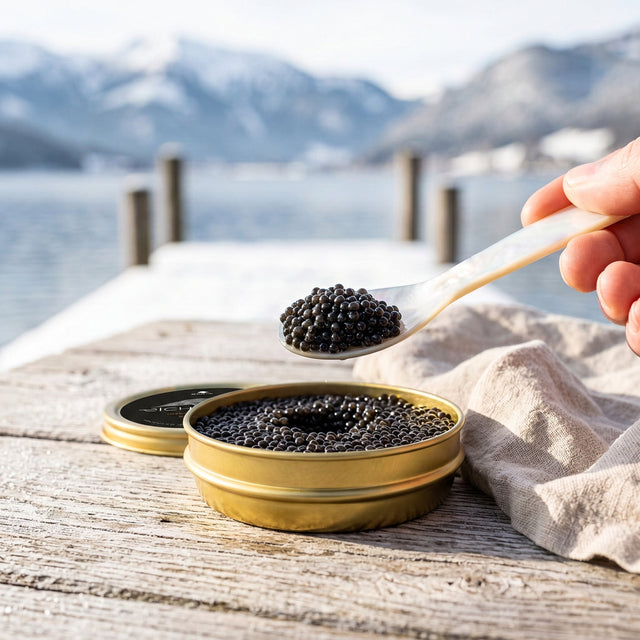
- Use a spoon that isn't metal. Mother of pearl, horn, wood or glass. Silver and steel can leave a metallic note – see how to eat caviar.
- Taste it plain first. Half a teaspoon, straight from the spoon or from the back of your hand – the caviar bump. Skin is neutral and slightly warm, so it brings out the aroma.
- Don't chew. Let the pearls rest on your tongue, then press them gently.
- Wait. Salt first, then butter and nut, then the finish. Only after that, try it on a blini or a warm potato.
Does caviar taste like salmon roe?
No. Salmon and trout roe are larger, juicier and brighter, with a clear "pop" and a fresh, slightly sweet taste. Sturgeon caviar is smaller, creamier and nuttier, with a longer finish. Our own trout roe, Red Pearl, belongs to a different moment than sturgeon caviar: trout roe to an aperitif, sturgeon caviar to the centre of the table.
What to drink so the taste comes through
A dry Champagne or a very cold, neutral vodka. Both clean the palate between bites and let the next spoonful taste as good as the first. Anything sweet makes caviar taste saltier and slightly metallic. More pairings are in pairing caviar with spirits.
FAQ
Is caviar an acquired taste?
Less than people expect. Most people who dislike caviar have tasted old, pasteurised or very salty roe. A fresh, lightly salted caviar such as Imperial Baerii is mild and creamy enough for a first try.
Why does some caviar taste metallic?
Usually because of the spoon (silver or steel), a sweet drink alongside, or caviar that has been opened for too long. Fresh caviar from a neutral spoon should not taste metallic.
Is caviar supposed to taste salty?
Gently salty, yes – like sea air, not like a salted snack. If salt is all you taste, the caviar was salted heavily to make it last.
Which caviar tastes the mildest?
Royal Albino, followed by Imperial Baerii. At the other end, Titan Selection has the most complex, creamiest flavour of our sturgeon caviars, and Osietra the most mineral.
Does caviar taste better cold?
Yes, but not ice-cold. Straight from the fridge the flavour is muted; after a few minutes on crushed ice it opens up while the pearls stay firm.